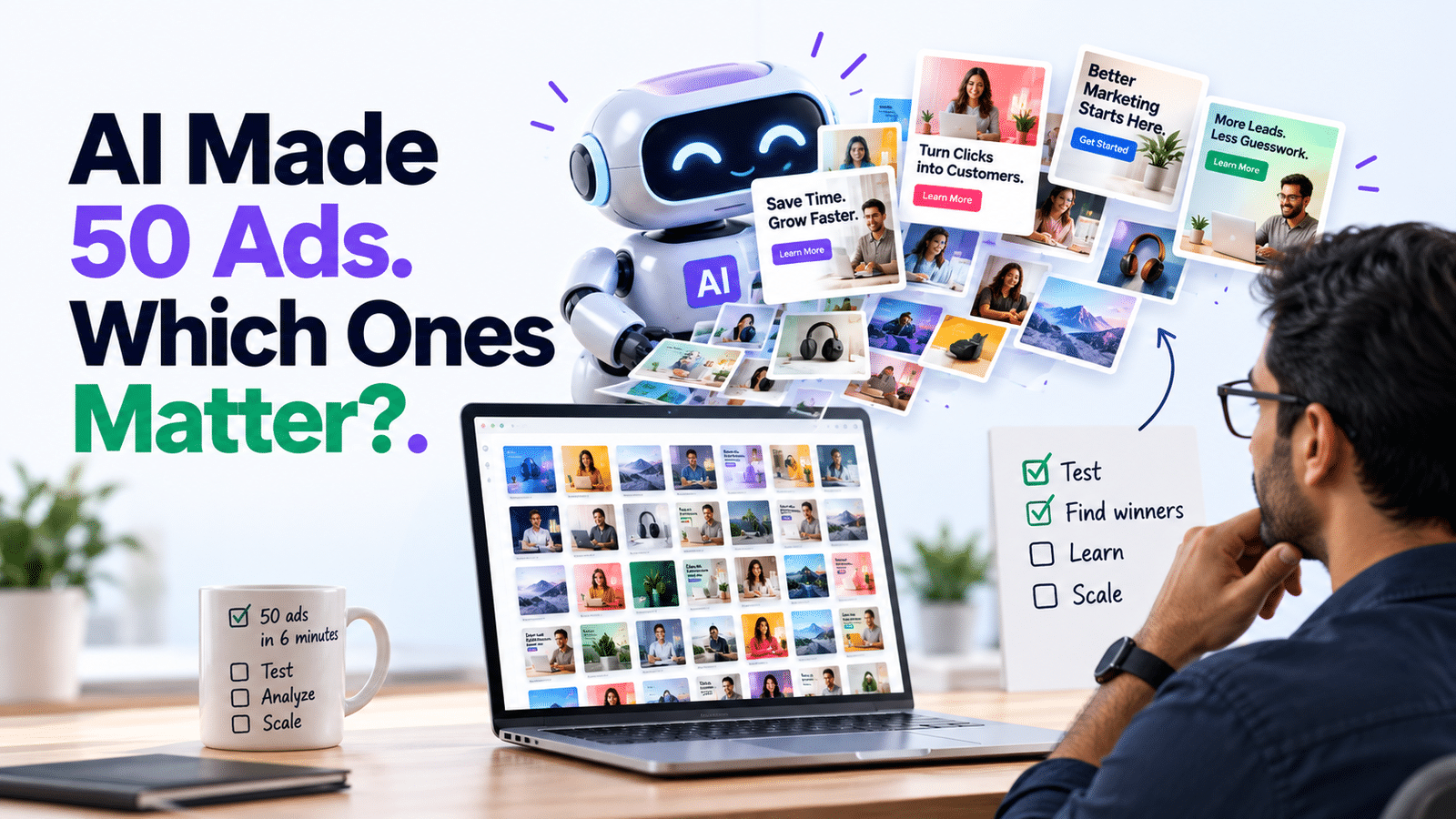
AI Made 50 Ads. Which Ones Matter?
AI just created 50 ads for you in six minutes.
Fantastic.
Now which ones are you going to spend actual money on?
Because generating 50 ads isn’t a marketing strategy.
It’s a folder.
AI has made producing creative ridiculously easy. Headlines, images, descriptions and variations that once took days can now appear before your coffee gets cold.
The bottleneck has moved.
The challenge isn’t creating more ads. It’s figuring out which ideas deserve testing and what you’re actually trying to learn.
1. More creative doesn’t mean more testing
Changing a headline from “Grow Your Business” to “Grow Your Business Today” technically gives you another ad.
Congratulations on your groundbreaking experiment.
Good testing compares meaningful differences: different customer problems, offers, hooks, proof points or creative concepts.
Fifty tiny variations can produce plenty of data without producing much insight.
2. Start with a hypothesis, not a prompt
Before asking AI to create variations, decide what you’re testing.
Maybe you believe customers care more about saving time than saving money.
Great.
Create ads around both messages and compare the results.
Now the test can teach you something about your customer instead of merely identifying which AI-generated headline got three more clicks.
3. Test big differences first
Start with variables capable of changing someone’s decision.
Compare:
Price vs. convenience.
Product features vs. customer outcomes.
Testimonials vs. demonstrations.
Problem-focused vs. benefit-focused messaging.
Once you identify a promising direction, test smaller variations within it.
Otherwise, you can spend weeks optimizing the punctuation on an idea nobody particularly cares about.
4. Don’t outsource all the thinking to the algorithm
Advertising platforms are extremely good at distributing creative toward people likely to respond.
That doesn’t mean marketers should stop asking why something worked.
Was it the offer? The visual? The opening hook? The audience? The problem being addressed?
AI and algorithms can optimize quickly.
Human marketers still need to extract the lesson.
That’s similar to why 5 Marketing Tasks AI Shouldn’t Do for You argued for keeping humans involved when context and judgment matter.
5. Turn winners into learnings
Suppose Ad #37 wins.
Wonderful.
Don’t just duplicate Ad #37 fourteen times.
Ask what it revealed.
Perhaps customers responded to a specific pain point. Maybe testimonials increased trust. Perhaps your “premium quality” message performed worse than your “save three hours every week” message.
That insight can influence your landing pages, emails, sales messaging and future campaigns.
The takeaway
AI has dramatically lowered the cost of producing marketing creative.
That’s useful.
But if your strategy becomes generate everything, launch everything and let the algorithm figure it out, you’ve automated production without improving your marketing intelligence.
Use AI to create variations quickly.
Use structured testing to discover what customers actually respond to.
Then use those learnings everywhere.
Because the goal isn’t to make 50 ads.
It’s to make the next five better.