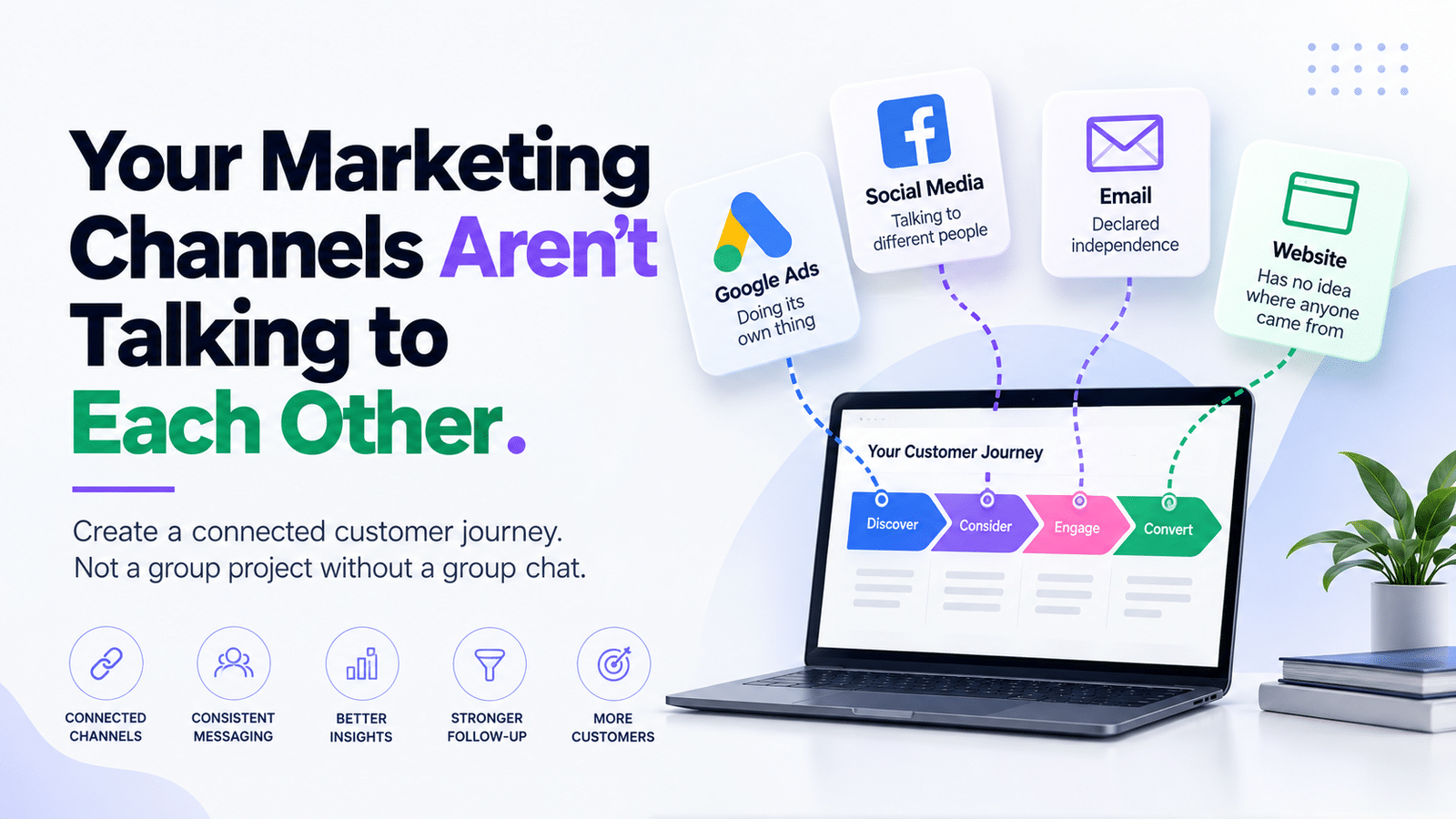
Your Marketing Channels Aren’t Talking to Each Other
Google Ads is doing one thing.
Facebook is doing another.
Email has apparently declared independence.
And your website has no idea where anybody came from.
Congratulations. You don’t have a marketing funnel. You have several marketing departments that have never met.
Customers rarely experience marketing one channel at a time. They might discover you on social media, search your business on Google three days later, read a blog post, disappear for two weeks, open an email and finally request a quote.
Your marketing needs to work the same way.
Here are five places to start.
1. Give each channel a job
Not every channel needs to generate the final conversion.
Social might introduce your brand. Search captures existing demand. Content answers questions. Email nurtures prospects. Your website converts interest into action.
If every channel is being judged solely by immediate leads, you may end up cutting something that quietly helps another channel perform.
2. Keep the message connected
Someone sees an ad promising “Free Marketing Audit.”
They click.
The landing page starts talking about your company’s 14-year journey and commitment to innovation.
Excellent. Perhaps the free audit is hiding somewhere near the company Christmas photos.
Your offer, message and CTA should remain consistent as people move between channels.
3. Track where people actually come from
Your CRM says:
Source: Website
Very informative.
How did they reach the website?
Use UTMs, analytics, CRM source fields and conversion tracking to preserve that information.
Otherwise, every channel contributes to the journey and the website mysteriously gets all the credit.
4. Connect your follow-up
Marketing shouldn’t forget everything it knows about someone the moment they become a lead.
A person who downloaded a guide should receive different follow-up from someone requesting a quote.
Someone who attended a webinar shouldn’t be treated exactly like someone who clicked an Instagram ad yesterday.
Use your CRM and automation to carry context forward.
That’s also why 5 Marketing Tasks You Should Automate includes lead notifications and follow-ups. Automation becomes much more useful when your systems actually share information.
5. Report on the journey, not just the channels
Google Ads generated twelve leads.
Social generated four.
Email generated seven.
Nice spreadsheet.
But what if social introduced six customers who later converted through Google?
Channel-by-channel reporting can hide how marketing actually works.
Look for patterns across the customer journey and ask how channels assist each other, not simply which one gets the final conversion.
The takeaway
Your customers don’t care which marketing department owns which channel.
They see one business.
Your ads, social content, emails, website and sales follow-up should feel like they’re part of the same conversation.
Because when every channel operates independently, you don’t have a full-funnel strategy.
You have a group project where nobody created the group chat.