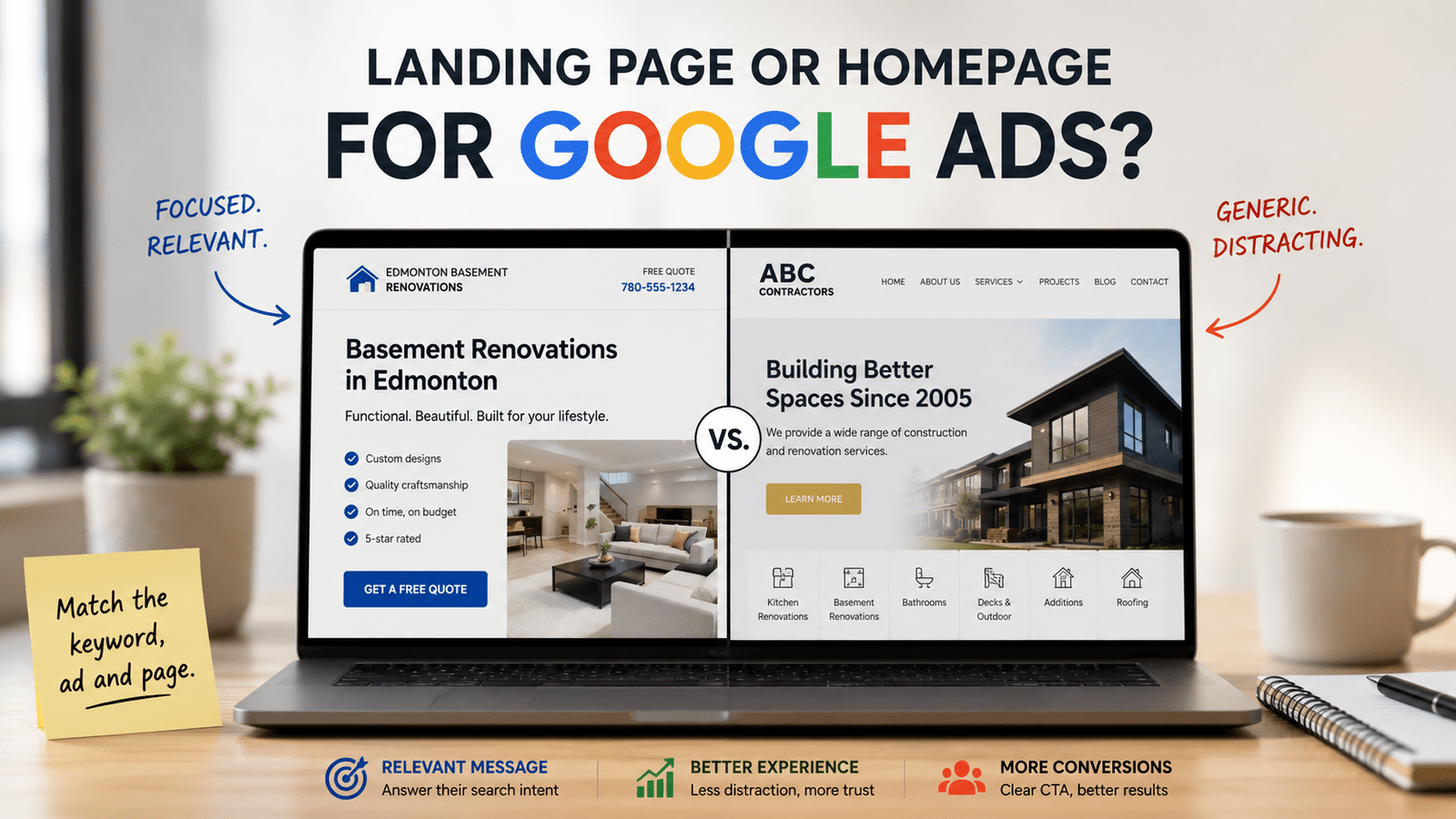
You’re setting up a Google Ads campaign and need to choose where people go after clicking your ad.
Do you send them to your homepage, or do you need to build a landing page?
The answer: it depends on what your ad is promising.
Your homepage isn’t automatically a bad choice
Suppose you run a small plumbing company and someone searches for your business name. Sending them to your homepage may make perfect sense. They can see your services, learn about the company and contact you.
But consider a different search:
“Emergency plumber Edmonton”
Your ad says:
24/7 Emergency Plumbing | Call Now
If someone clicks and lands on a homepage where emergency plumbing is buried among ten other services, you’re making them search for what they already asked for.
When a landing page makes sense
A dedicated landing page becomes useful when you’re advertising a specific service, product, location or offer.
The page should continue the conversation started by the search and the ad.
Someone searches “basement renovation Edmonton” → sees an ad about basement renovations → lands on a page about basement renovations.
Not your roofing, kitchens, decks and company history.
The page should quickly answer:
Am I in the right place? What are you offering? Why should I trust you? What do I do next?
That usually means a clear headline, relevant information, proof such as reviews or project examples, and an obvious CTA.
Don’t build landing pages just because you can
You don’t necessarily need a new page for every campaign.
If an existing service page closely matches the search, ad and intended action, it may already be a perfectly good destination.
The goal isn’t homepage vs. landing page.
It’s:
Search → Ad → Relevant Page → Clear Next Step
Your landing page is also only one part of campaign preparation. Before launching, work through “What to Do Before Spending Money on Google Ads” for the other fundamentals worth checking.