


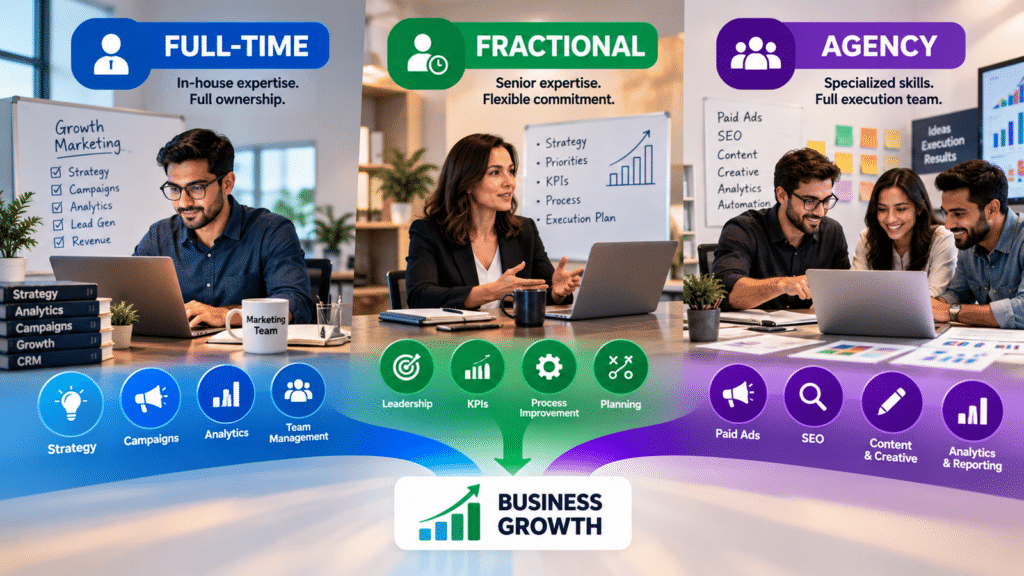
Full-Time, Fractional or Agency?
Your business needs more leads, better conversions and actual revenue growth.
Naturally, someone suggests hiring a full-time growth marketer.
Someone else recommends a fractional CMO.
And three agencies have already emailed you promising to “10X your growth.”
Wonderful.
Three solutions. Three invoices. One business problem.
So which one should you choose?
1. Full-time: When marketing needs an owner
A full-time growth marketer lives inside your business.
They understand your products, customers, sales team, internal politics and why that supposedly brilliant campaign from last quarter was quietly abandoned.
They’re ideal when marketing requires daily decisions, cross-functional coordination and continuous experimentation.
The downside? Salary, benefits, recruitment, tools and management costs.
Hiring someone full-time doesn’t automatically mean you’ve hired the right strategy.
2. Fractional: When you need expertise, not 40 hours
A fractional marketing leader brings senior-level thinking without a full-time commitment.
They can develop strategy, establish KPIs, prioritize channels, improve processes and hold execution accountable.
Great for businesses that need experienced leadership but aren’t ready for a permanent senior hire.
The catch?
A fractional leader isn’t necessarily your entire marketing department.
A brilliant strategy that nobody has time to execute is still a very attractive PowerPoint presentation.
3. Agency: When you need specialized execution
Agencies bring expertise across advertising, SEO, content, creative, analytics and automation.
Instead of hiring five specialists, you can access a team with established processes and tools.
Excellent when you need capabilities quickly.
But agencies don’t automatically understand your business.
Without clear objectives, communication and accountability, you may receive beautiful reports explaining how wonderfully your impressions are performing.
Meanwhile, Sales is wondering where the customers went.
4. Stop comparing fees. Compare outcomes.
The cheapest option isn’t automatically the smartest.
Compare the total investment, capabilities, execution capacity and expected business contribution.
Most importantly, ask:
Who owns the outcome?
Not the campaign launch. Not the content calendar. Not the dashboard.
The outcome.
5. Sometimes the best answer is a combination
A growing business might use a fractional leader to establish strategy, an agency for specialized execution and an internal employee to coordinate operations.
A larger organization may benefit from a full-time growth leader supported by agencies.
There’s no universal formula.
As discussed in Digital vs. Traditional Marketing? Wrong Question, the channel matters less than the measurable business outcome.
The same principle applies to how you organize your marketing team.
The takeaway
Don’t hire a full-time marketer because successful companies have marketing departments.
Don’t hire a fractional CMO because LinkedIn says it’s the future.
And don’t hire an agency because its website features impressive client logos and the word “synergy” seventeen times.
Start with your business problem.
Determine what expertise, leadership and execution you actually need.
Then choose the model that can deliver it.
Because growth marketing isn’t about how many marketers you’re paying.
It’s about whether the business is growing.