


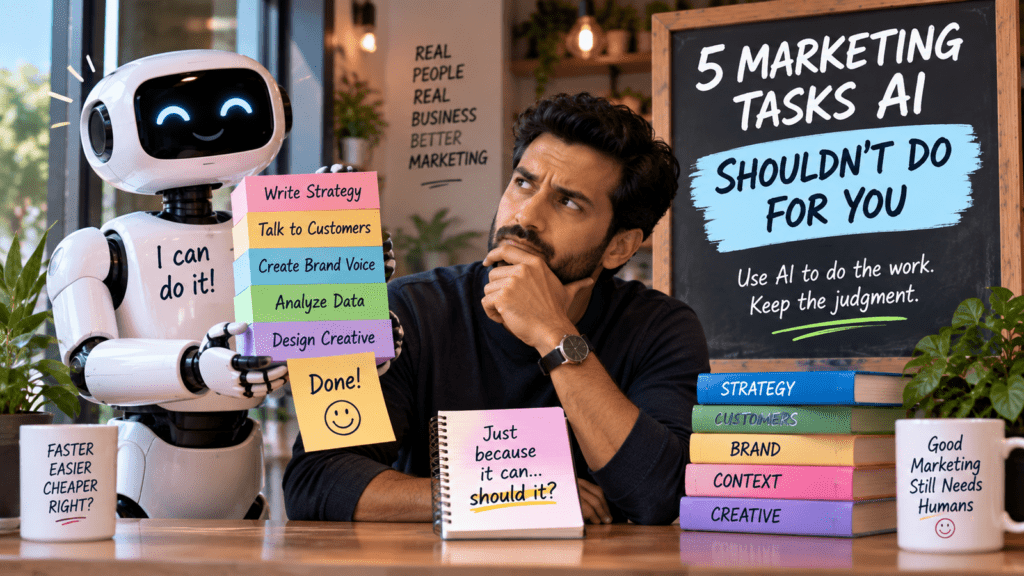
5 Marketing Tasks AI Shouldn’t Do for You
AI can write 30 social posts before you’ve finished your coffee.
Wonderful.
If they’re all generic nonsense nobody wants to read, congratulations, you’ve automated being ignored.
AI is incredibly useful for marketing. It can research, summarize, organize, brainstorm, analyze and automate repetitive work.
But being able to automate something doesn’t necessarily mean you should.
There’s a great moment in Jurassic Park where Ian Malcolm criticizes the scientists for becoming so focused on whether they could use the technology that they failed to properly consider whether they should.
Marketing teams could probably use a little Ian Malcolm right now.
AI can write your strategy. It can answer customers. It can create content, generate ads and analyze mountains of data.
The better question is:
Should it be making all those decisions for you?
Here are five marketing tasks where humans should probably remain involved.
1. Deciding your marketing strategy
AI can research competitors, organize ideas and identify opportunities.
But it doesn’t sit in your sales meetings. It doesn’t hear customers complain. It may not know that your most profitable service is completely different from the one getting the most website traffic.
Use AI to inform your strategy.
Don’t type “create my marketing strategy,” copy the answer into PowerPoint and declare Q4 officially solved.
2. Having important customer conversations
Chatbots are great for answering common questions, collecting information and routing inquiries.
But complicated questions, serious complaints and high-value opportunities often need a human.
Customers appreciate efficiency.
They’re considerably less enthusiastic about arguing with a chatbot for 17 minutes while desperately typing “HUMAN.”
3. Creating your entire brand voice
AI can absolutely help you write.
The problem starts when every email, blog and social post sounds like the same extremely enthusiastic robot who is “thrilled to announce” absolutely everything.
Give AI examples of your voice. Edit what it produces. Add opinions, experience and personality.
Your competitors have access to the same AI tools.
They don’t have your perspective.
4. Interpreting business context
AI can spot patterns in marketing data quickly.
But numbers need context.
Maybe demand is seasonal. Perhaps sales changed because your best salesperson left. A competitor could have launched a promotion, your pricing might have changed, or the tracking could simply be broken.
AI can help investigate.
A human still needs to decide whether the explanation actually makes sense.
That’s also why marketing reports should provide answers, not just more data.
5. Approving the final creative
AI can generate headlines, images, ads and videos incredibly quickly.
It can also confidently produce something completely ridiculous incredibly quickly.
Before anything goes live, someone should check the facts, spelling, branding, offer, CTA and whether the creative makes sense to an actual customer.
“The AI made it” is not a particularly strong quality-control process.
The takeaway
This isn’t an argument against AI.
Use it. A lot.
Let it brainstorm, summarize, analyze, organize and automate repetitive work.
But keep humans involved where context, strategy, relationships and judgment matter.
The goal isn’t to automate everything simply because technology makes it possible.
Automate the boring stuff so humans have more time for the important stuff.
Ian Malcolm might approve.
Although, considering how things went at Jurassic Park, perhaps we shouldn’t ask the dinosaurs.