


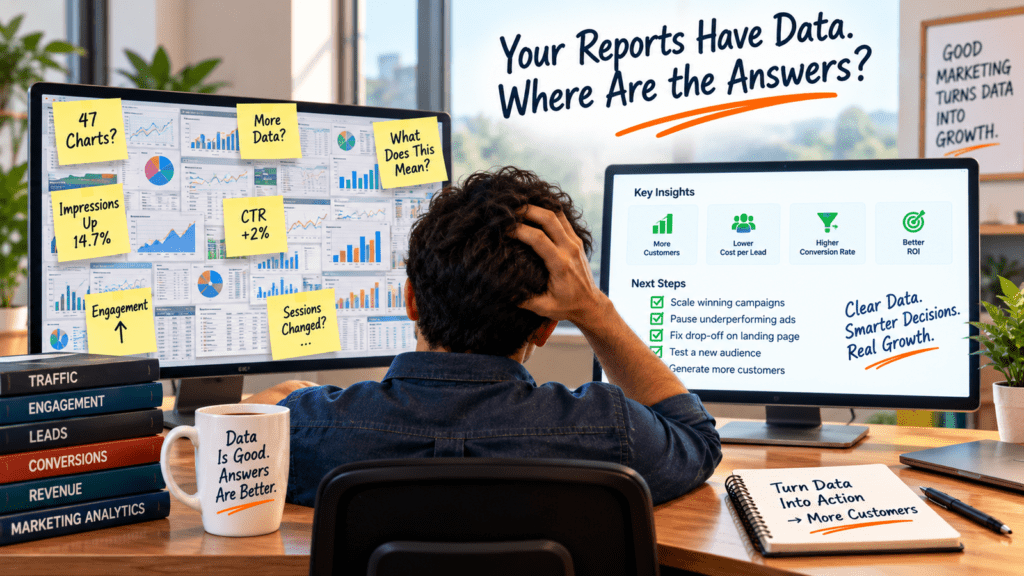
Your Reports Have Data. Where Are the Answers?
Congratulations, your dashboard has 47 charts. Do you know what you should actually do differently on Monday?
If the answer is no, you don’t have an analytics problem.
You have a “lots of data, not many answers” problem.
Marketing reports shouldn’t just tell you what happened. They should help you decide what to do next.
Here are five questions your reports should actually answer.
1. What’s generating customers?
Traffic matters. Clicks matter. Engagement can matter.
But eventually, somebody needs to buy something.
Your reporting should connect marketing activity to leads, qualified leads, sales or another meaningful business outcome.
Otherwise, congratulations on the 23,000 impressions.
2. What’s wasting money?
Good reporting shouldn’t only celebrate the winners.
Look for campaigns, keywords, audiences and channels consuming budget without producing meaningful results.
A campaign generating $20 leads might look fantastic until you discover none of those leads ever become customers.
We’ve covered this before in Are Your Cheap Leads Actually Good Leads?.
Cheap isn’t necessarily profitable.
3. Where are people dropping off?
Maybe your ads work perfectly.
People click, reach your website and then disappear into the internet wilderness.
Look at the whole journey:
Ad → Website → Form → Lead → Appointment → Customer
Where does the biggest drop happen?
That’s probably more useful than knowing your homepage received 1,437 sessions last month.
4. What actually changed?
Conversions dropped 20%.
Okay. Why?
Maybe traffic declined. Perhaps your conversion rate fell, the budget changed, one campaign stopped performing, or your tracking simply broke somewhere along the way.
A useful report provides context instead of making you play detective every Monday morning.
5. What should we do next?
This is the question that separates reporting from analysis.
“Website traffic increased 8%” is data.
“Organic traffic increased 8%, but leads stayed flat, so we should investigate which pages are attracting visitors without converting” is an insight.
And an insight gives you something to do.
Pause a campaign. Increase a budget. Fix tracking. Rewrite a landing page. Test another audience. Improve lead follow-up.
The takeaway
You probably don’t need another dashboard.
You need better questions.
A useful marketing report shouldn’t require an analytics degree and three cups of coffee to understand.
Data tells you what happened. Analysis tells you what to do about it.
That’s when those 47 charts finally start earning their screen space.